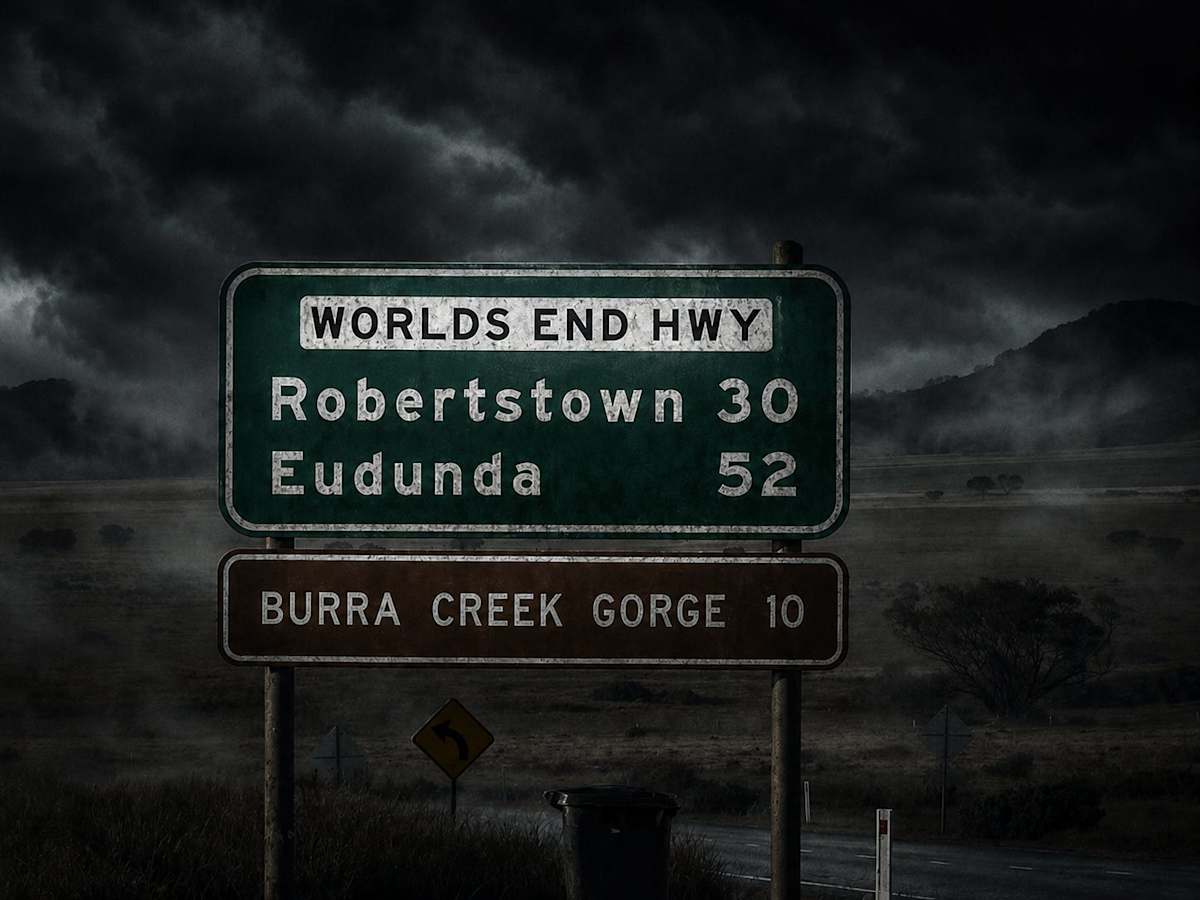
Near Burra in South Australia’s Mid North lies a place with one of the state’s most intriguing names—World’s End.
The settlement of Lapford, surveyed in 1877, was once located in what is now known as World’s End. Although the township was planned, it never really took off. Even so, the district had a thriving community for many years. A post office operated from 1876 until 1971; a school opened in 1888 and closed in 1941 due to a shortage of teachers; and a Wesleyan church served the community from 1889 until 1975. Today, the ruins of many of these buildings can still be seen along the World’s End driving trail.
The origin of the name “World’s End” has inspired a few stories over the years. One popular tale links it to Goyder’s Line, suggesting it marked the edge of reliable farming country. It’s a romantic idea, but it isn’t true. The name predates Goyder’s Line by 15 years. It was given by Scotsman Donald McDonald, who established the World’s End pastoral station in 1851.[1]
For a Scot, the name “World’s End” would have carried a very different meaning. It recalls the aftermath of the Battle of Flodden in 1513, when the English defeated the Scots. Fearing Edinburgh was left vulnerable, King James IV ordered defensive walls to be built around the city. A pub just beyond those walls became known as the World’s End because it stood outside the city’s protection—the point where the safe world ended. That historic pub still stands today, and the present building exists on the foundations of the original Flodden Wall.[2]
The Edinburgh World’s End was just one of many inns and pubs that adopted the name on the outskirts of Scottish towns. Donald McDonald, who came from Aberdeenshire, would also have been familiar with World’s End House, built there in 1767 and associated with the Scottish folk tale of the Well of World’s End.[3] With such familiar and affectionate associations back home, it’s easy to see why McDonald chose the name for his pastoral run in colonial South Australia.
In 1908, at The World’s End, South Australia, it was reported that multiple ghosts had been terrifying residents. One incident involved a team of horses that took off from their owner after encountering the ghost. The ghost scared the horses so much that they fled. In an interview with the Burra Record (newspaper), the witness explained that it was not a white-robed ghost he witnessed but the ghosts of a little girl and a little boy. He stated in an interview, ‘it was on account of their tender years that he decided to speak to them concerning their early morning travels, and as he did so the forms disappeared, in the most mysterious fashion.’[4]
On another occasion, a woman was doing her laundry. She pinned some white bed sheets to her clothesline. Later that evening, she went out to collect her sheets and noticed one had been removed and thrown some distance away. Rather than being logical and thinking the wind did it, she instantly blamed ghosts! She rallied her family, they armed themselves with sticks and other weapons, and went and beat the bed sheet, as if it were the ghosts, only to find it was just a bed sheet.[5]
Have you been to World’s End? Have you seen a ghost? Let me know in the comments.
© Allen Tiller 2026
[1] ‘Late William McDonald’, The Proserpine Guardian, (29 February 1936), p. 6.
[2] About The World’s End, Belhaven, (2026), https://www.belhaven.co.uk/pubs/edinburgh/worlds-end
[3] Joseph Jacobs, ‘The Well of the World’s End’, (1890), https://www.authorama.com/english-fairy-tales-44.html
[4] ‘The Ghosts.’, Burra Record, (25 November 1908), p. 2.
[5] ‘The Ghost.’, Burra Record, (18 November 1908), p. 2.